Source Electric Double Tank Fryer for Restaurants, Fast Food, and Catering
Compare 30 electric double tank fryer models with varying capacities, voltages, and dimensions for commercial kitchens. Options include units with and without timing devices, featuring stainless steel construction and capacities from 4+4L to 28+28L for diverse food processing needs.
Key considerations
Products List




Comprehensive Sourcing Guide
Strategic Sourcing Guide for Electric Double Tank Fryers
Understanding Technical Specifications and Configuration Variants
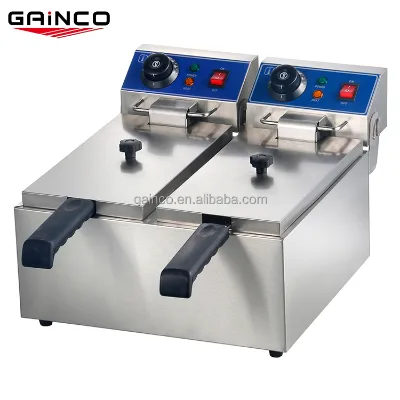
When sourcing an electric double tank fryer for commercial operations, the primary objective is to align equipment specifications with specific production volumes and kitchen layouts. The market presents a diverse array of configurations, ranging from compact countertop units to large-scale industrial systems. A critical observation from current product listings indicates that capacity is a primary differentiator. Buyers must distinguish between models offering dual 4-liter tanks, dual 6-liter tanks, and larger dual 8-liter configurations. These variations directly impact throughput capabilities and the physical footprint required within a commercial kitchen.
The physical dimensions of the fryer are equally critical for space planning. Data indicates that specific models, such as the GDEF series, feature standard dimensions around 540mm in width, with depths varying between 635mm and 658mm depending on the tank capacity. Larger industrial units, such as those designed for high-volume fast food applications, can reach dimensions of 800mm by 800mm with heights exceeding 1.1 meters. The internal construction often utilizes stainless steel materials, which are essential for durability and hygiene in high-temperature environments. Furthermore, the basket configuration is a key technical detail; some units are designed with four baskets to facilitate simultaneous cooking cycles, while others may vary in basket count based on the specific model.
Voltage requirements represent another significant technical variable that must be verified before procurement. The supply chain shows a split between standard single-phase voltages, typically ranging from 220V to 240V, and three-phase industrial voltages at 380V. Selecting the incorrect voltage rating can lead to equipment failure or safety hazards. Additionally, the presence or absence of a timing device is a functional specification that varies by model. Some units are equipped with built-in timing devices to automate cooking cycles, while others operate without them, requiring manual monitoring. Buyers must explicitly confirm the presence of these features against their operational workflow requirements.
Compliance, Certification, and Safety Standards
In the commercial food service industry, regulatory compliance is non-negotiable. When evaluating electric double tank fryers, buyers must prioritize products that carry recognized safety certifications. The most frequently observed certification in the current market data is the CE mark, which indicates conformity with health, safety, and environmental protection standards for products sold within the European Economic Area. Another critical certification noted is LFGB, which pertains to food safety and material safety standards in Germany and is often accepted as a benchmark for food-contact materials globally.
While specific standards such as ASTM F1361 or ASTM F2144 are sometimes referenced in broader industry contexts, buyers should exercise caution and verify if these specific standards apply to the specific fryer model being considered. Relying on general background knowledge without explicit product confirmation can lead to compliance gaps. Instead, the procurement process should focus on verifying that the manufacturer provides valid, up-to-date certification documents for the specific batch or model number. The origin of the product, often listed as China or specifically Guangdong Province, should be cross-referenced with the certification documentation to ensure the manufacturing facility is audited and approved.
Safety features extend beyond certification marks to include the physical design of the unit. The use of double tanks often implies a need for independent temperature control or filtration systems. Buyers should verify the presence of filtration pots with fast connections, as this feature significantly impacts maintenance efficiency and oil longevity. The material composition, specifically stainless steel, must be confirmed to ensure resistance to corrosion and ease of cleaning, which are vital for maintaining hygiene standards in commercial kitchens.
Cost Drivers and Pricing Structure Analysis
The pricing of electric double tank fryers is influenced by a complex interplay of factors, including capacity, material quality, voltage requirements, and the inclusion of advanced features like timing devices. Market observations indicate a wide price range, with units listed between $25 and $1,800 USD. This broad spectrum reflects the difference between basic, smaller capacity models and heavy-duty, high-capacity industrial units.
Several specific cost drivers must be analyzed during the budgeting phase. First, the capacity of the tanks is a primary determinant; units with 28+28 liter capacities will naturally command a higher price point than those with 4+4 liter capacities. Second, the weight of the unit, indicated by Net Weight (N.W) and Gross Weight (G.W), correlates with the amount of material used. For instance, a unit with a net weight of 105kg and a gross weight of 125kg represents a significantly heavier, more robust construction compared to a unit weighing 10kg. This weight difference often translates to higher material costs and potentially higher shipping expenses.
Packaging requirements also influence the final cost. Units packaged in simple cartons may have lower associated costs compared to those requiring plywood crates or specialized packaging to protect heavy components during international transit. The power consumption rating, such as 2.5kW or 5kW, can also impact the price, as higher power ratings often require more robust internal components and electrical systems. Buyers should be aware that the Minimum Order Quantity (MOQ) can vary from 1 to 20 units, which affects the unit price through economies of scale. Understanding these variables allows for a more accurate total cost of ownership calculation, factoring in not just the purchase price but also installation, energy consumption, and maintenance.
Typical Applications and Operational Use Cases
Electric double tank fryers are designed to meet the rigorous demands of various commercial food service environments. The versatility of these units makes them suitable for a wide range of applications, from small cafes to large-scale fast food restaurants. The specific application places identified in the market data include fast food restaurants, where high throughput and consistency are paramount. In these settings, the ability to cook multiple batches simultaneously using dual tanks and multiple baskets is a significant operational advantage.
The process type for these fryers is primarily thermal processing, which involves heating oil to precise temperatures to cook food items such as chips and other fried goods. The temperature range of 50°C to 190°C allows for flexibility in cooking different types of food, from delicate items requiring lower temperatures to crispy foods needing higher heat. The automatic grade of the equipment is typically manual, meaning the operator controls the frying process, though the inclusion of timing devices can automate specific aspects of the cycle.
For operations focusing on specific products like chips, the filtration system becomes a critical component. Units equipped with fast connection filtration pots allow for efficient oil management, reducing downtime and ensuring consistent oil quality. The double tank design also facilitates the separation of different food types or the maintenance of oil quality by allowing one tank to be cleaned while the other remains in operation. This operational flexibility is essential for businesses that need to maintain high service levels during peak hours.
Supplier Evaluation and Verification Protocols
Evaluating suppliers for electric double tank fryers requires a rigorous due diligence process to ensure reliability and product quality. Buyers should prioritize suppliers who provide transparent information regarding product origin, such as Guangdong, China, and who can substantiate their claims with verifiable documentation. The presence of customization options is another key indicator of a flexible and capable supplier. Some models are listed as "Customized" or "Non-Customized," and buyers should clarify their specific requirements for branding, voltage, or capacity modifications early in the negotiation process.
When assessing a supplier, it is crucial to verify the consistency of the product specifications. Discrepancies between the listed model numbers, such as GDEF8L2 versus GDEF6L2, and their corresponding dimensions or capacities can indicate a lack of standardization or potential quality control issues. Buyers should request detailed technical datasheets that match the observed attributes, including voltage, power source, and material composition. The packaging method, whether it is carton or plywood with carton, should also be confirmed to ensure safe delivery.
Furthermore, the supplier's ability to support the product after the sale is a vital consideration. This includes the availability of spare parts, such as baskets and filtration pots, and the provision of technical support for installation and maintenance. While specific lead times and MOQ values vary, buyers should establish clear expectations regarding these terms before finalizing any agreement. The goal is to partner with a supplier who demonstrates a commitment to quality and service, rather than simply offering the lowest price.
Quality Control and Long-Term Procurement Considerations
Implementing a robust quality control (QC) strategy is essential for mitigating risks associated with the procurement of electric double tank fryers. Given the variation in product attributes, such as voltage, capacity, and material, buyers should establish clear acceptance criteria before production or shipment. This includes verifying the physical dimensions, ensuring the stainless steel material meets hygiene standards, and confirming that the electrical components match the specified voltage and power ratings.
Long-term procurement considerations extend beyond the initial purchase to include maintenance, energy efficiency, and lifecycle costs. The thermal processing nature of these fryers means that energy consumption will be a recurring cost. Models with higher power ratings, such as 5kW, may offer faster heating times but could incur higher energy bills compared to lower-power units. Buyers should evaluate the trade-off between speed and efficiency based on their specific operational needs.
Additionally, the durability of the unit is a critical factor. The use of stainless steel and robust packaging suggests a focus on longevity, but the actual performance in a high-heat, high-moisture environment must be validated. Regular maintenance of the filtration system and temperature controls is necessary to ensure consistent performance and food safety. By focusing on these long-term factors, buyers can make informed decisions that maximize the return on investment and ensure the continued reliability of their kitchen equipment.
FAQs
What certifications do electric double tank fryers have?
Electric double tank fryers typically carry CE and LFGB certifications. These marks indicate compliance with safety and food contact standards, ensuring the equipment meets regulatory requirements for commercial use in various regions.
Which voltage options are available for these fryers?
Available voltage options include 220-240V and 380V. Buyers must select the correct voltage rating to match their local power supply, as using an incorrect voltage can lead to equipment failure or safety hazards.
Can I customize the capacity of the fryer tanks?
Customization is available for tank capacity, with options like 4+4L, 6+6L, and 8+8L configurations. Some models also offer larger industrial capacities up to 28+28L to suit different production volume requirements.
What is the price range for commercial electric fryers?
The observed price range for these units is between 25 and 1800 USD. Pricing varies significantly based on capacity, material quality, power rating, and whether the unit includes advanced features like timing devices.
How does the timing device affect operation?
Some models come with a timing device while others operate without one. Units with timing devices automate cooking cycles for consistency, whereas manual models require the operator to monitor cooking times directly.
What material is used for the fryer construction?
The fryers are constructed from stainless steel material. This ensures durability, resistance to corrosion, and ease of cleaning, which are essential for maintaining hygiene standards in high-temperature commercial kitchen environments.
Where are these fryers typically manufactured?
These products originate from China, with specific manufacturing hubs in Guangdong. Buyers should verify the origin against certification documents to ensure the facility meets required quality and safety audit standards.